Monday, May 7, 2012

Some puzzling card tricks

For the Puzzlers badge, we learned these three card tricks, which use mathematical or logical thinking. At the end of each trick is an explanation of how the trick works.


Mind-Reader Card

Place 12 cards on the table, using any cards from the deck, 6 of each color, in the same pattern as in the diagram above. Ask a volunteer to secretly choose any black card.

Ask her to move -- without touching the cards or letting you know which card she's on -- up or down to the nearest red card. (She may have to skip over a black card to get to a red one.)

Next, tell her to move left or right to the nearest black card.

Next, tell her to move diagonally to the nearest red card.

Finally, ask her to move up or down to the nearest black card. Tell your volunteer that you know exactly which card she is now on, and name the middle card in the bottom row!

This trick works because the specific arrangement of colors and moves forces the volunteer to end up on the middle card in the bottom row. Many of the moves will have only one possible direction; for example, there may not be a red card below, so she has to move up. Thus, no matter where she starts, her next-to-last move will always land her on a red card in the middle column, and her last will move down to the “mind-reader” card, because there is no black card to move “up” to in the middle column! 

The Rock Concert Trick
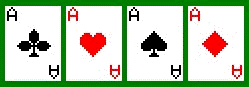
 

Read all of the way through this trick first, so that you are sure you know what’s coming. First, go through the deck and pull out all of the aces, kings, queens, and jacks. It’s okay for the audience to see this. Lay the rest of the deck aside; you won’t be using it. This trick has a basic "patter" for you to say as you perform it. You will "say" the parts in quotation marks, and [do] the parts in square brackets. You can use the name of your favorite singer or band; feel free to add details to the story.

"The Ace family is going to a rock concert." [Lay the aces face-up on the table in a row as in the illustration above.]


"The King family is also going to the concert, and they chat with their friends in line." [Lay the four kings face-up on top of the four aces, so that all cards are visible.]


"Then the Queen family joins up with their friends, the Aces and the Kings." [Lay the four queens face-up on top of the previous stacks.]


"The Jack family is also going to the concert, and they meet their friends in line." [Lay the four jacks face-up, in the same way.]


"Now it’s almost time for the concert to start, so the four families head off to their seats." [Turn over each stack, one at a time, so that they are face-down.]


[Pick up the first stack and place it on top of the next stack, then pick up this new, bigger stack and place it on top of the next one, and again with the last stack. It doesn’t matter whether you go left to right or right to left. You now have one big stack of cards.]

Ask for a volunteer from your audience, and say to her, "Okay, cut the cards by taking a group of cards off the top of the stack and placing them on the table, then put the remaining cards on top of the stack. Cut the cards as many times as you want." [Let her cut the cards a few times, then deal the first four cards face-down in a row, then the next four cards on top of the first four, and so on -- just as you did when you first dealt them out, except that this time they are all face-down -- until all sixteen cards are dealt out.]

 "Now each family is sitting together, enjoying the concert!" [Turn over each stack to reveal that the kings are all together in one stack, the queens are together, and so on.]

How this trick works: After you have dealt out the four “families”, each stack is in a specific order: ace, king, queen, jack. When you turn them over and make one big stack, the cards are still in this order, but it is repeated four times: ace, king, queen, jack, ace, king, queen, jack, and so on. When you cut the cards -- it must be done in the way described above, not in a random shuffle-- you are actually keeping the cards in the same basic order, just starting at a different point in the sequence. For example, at the beginning, the cards are in the order A K Q J A K Q J etc. After two or three cuts, it might go Q J A K Q J A K, but it is still the same sequence, just missing the first two at the beginning (because these are now at the end). When you deal out the cards in the last step of the trick, you are actually sorting them into their "families", although you won’t know where in the sequence you are starting until the reveal at the end.

Mysterious Math Card Trick

Start with a 52-card deck.

1. Have your volunteer shuffle the cards any way she likes, as many times as she likes. When she is finished, show her the bottom card so that you cannot see it, and tell her to memorize that card.

2. Turn over the top three cards, and place them in a line.

3. Deal cards face-down below each of these three cards in the following way: Start with the value of the first card (ace = 1, jack = 11, queen = 12, king = 13), and then keep dealing cards in a stack below that card until you get to 15. For example, if the first face-up card is a 9, you will deal six more cards face-down to get to 15. Repeat with the other two stacks.

4. Leaving the three face-up cards on the table, put all of the face-down cards on the bottom of the deck.

5. Ask your volunteer to add up the total value of the three face-up cards; for instance, 9 + queen (12) + 10 = 31). Deal out that many cards face-down, and put them on the bottom of the deck.

6. Tell your volunteer that you will now reveal her card. Lay out four cards face-up, one by one — the fourth card will be the one that your volunteer memorized!  

How this trick works: The object is to eventually remove all of the cards from the top of the deck in order to get to the target card at the bottom (the card you showed to your volunteer). Remember that the deck has 52 cards. The three face-up cards removed in Step 2 leave 49 in your hand (52 - 3). Now, in steps 3 through 5 you will remove a total of 45 cards, 15 for each face-up card (or 15 x 3). 

Let’s look at only one stack for a moment: In step 3, you deal out some number of cards to get up to 15, then in step 4 you put those cards at the bottom of the deck, and then in step 5 you deal out the remaining cards to total 15. Looking again at all three stacks together, you will always take off 15 + 15 + 15 -- it might be 8 + 7 in one stack, it might be 11 + 4 in another, but each will always total 15. (This is a variation on the associative property of addition, which states that changing the grouping of addends does not change the sum.) 

When you put these 45 cards (15 + 15+ 15) on the bottom of the deck, you force the target card closer to the top of the now 49-card deck (52 - 3 face-ups). Since 49 - 45 = 4, taking away four cards will bring your target card to the top!

Adapted from a trick posted by Raymond Blum at education.com.

Monday, February 27, 2012

Some basic tools

Here are some of the basic tools that everyone should know. Most of these come in a variety of shapes for different uses, but the basic outline will be recognizable.


A wrench is used for turning nuts and bolts. This one is an adjustable wrench.


A saw is used for cutting wood or metal. This one is a cross-cut saw.


A plane is used for making wood smooth or smaller. This one is a block plane.


Pliers are used for gripping things. These are bull-nosed pliers.


An awl is used for making holes, or to help you mark the spot where you want to put a nail. This is a scratch awl.


Sandpaper is used to smooth rough surfaces. It comes in a variety of grits (the size of the abrading material embedded in the paper).


A screwdriver is used for turning screws. This is a slotted screwdriver.


A drill is used for making deep holes. This one is a cordless electric drill.


A hammer is used for pounding and removing nails. This is a claw hammer.


A level is used for keeping angles and edges straight. This one is a spirit level.

All images from Wikipedia.

Sunday, January 29, 2012

Some more cookie sale clip art

These are some graphics from previous years' cookie sales, and from Girl Scouts USA (please right-click on the image you want and save it to your own hard drive):


You are welcome to use these graphics in e-mails and on FaceBook and other social networking sites, but please remember that Girl Scouts are not allowed to sell directly over the internet!

You may also print out any clip art and use it as you sell door-to-door.

Some cookie sale clip art

Here are some cookie sale graphics from ABC Bakers (please right-click on the image you want and save it to your own hard drive):


You are welcome to use these graphics in e-mails and on FaceBook and other social networking sites, but please remember that Girl Scouts are not allowed to sell directly over the internet!

You may also print out any clip art and use it as you sell door-to-door.

Monday, March 21, 2011

Thousand cranes for Japan


In Japan, an ancient legend promises that anyone who folds a thousand origami cranes will be granted a wish by a crane, such as long life or recovery from illness or injury. Senbazuru, the group of one thousand paper cranes threaded on string, are traditionally given as a wedding gift by the person who has folded them, as a wish for "a thousand years of happiness and prosperity" upon the couple. Senbazuru are also often given to a new baby for long life and good luck.

The Thousand Cranes has also become a symbol of world peace through the story of Sadako Sasaki, a Japanese girl who developed leukemia as a result of radiation from the atomic bombing of Hiroshima during World War II, and spent her time in the nursing home making a thousand origami cranes in hopes of getting well. Sadako's story is told in the book Sadako and the Thousand Paper Cranes by Eleanor Coerr (1977).

(Information and photo from Wikipedia.)

Here is our favorite set of instructions for folding a paper crane, from the Informed Democracy website.

Our thoughts are with our sister Girl Scouts of Japan and all of those affected by the March 11, 2011 earthquake and tsunami in northeast Japan.

Monday, November 29, 2010

"The Nutcracker" Girl Scout patch program

What is ballet?

Ballet is a form of theatre that uses dance to tell a story. It began in the 15th century in Italy, and developed further in France, England, and Russia.

The word ballet (pronounced bal-LAY) comes from the French, who in turned borrowed the word from the Italian balletto meaning "little dance". Ballet was so popular in France that most of the words used to describe the different dance steps are in French.

A ballet is different from a play because it uses dance and music to convey the story, instead of spoken words.

Marie Taglioni (1804-1884) dancing the title role in "La Sylphide", 1832 (Source: Wikipedia)

One of the most recognizable characteristics of ballet is the pointe shoe, the slippers that female dancers often wear. This slipper has a special hard toe that enables the dancer to stand on the very tips of her toes. One of the very first ballerinas to dance en pointe was Marie Taglioni, in the early 1830s.

Anna Pavlova (1881-1931), one of the most beloved of Russian ballerinas (Source: BallerinaGallery)

Maria Tallchief (b.1925), a famous Native-American ballerina (Source: The Osage Nation)

Suzanne Farrell (b.1945) (Source: Saturday Matinee)


What is "The Nutcracker"?

"The Nutcracker" is a two-act ballet composed by Peter Ilich Tchaikovsky. It was not originally much of a success when it debuted in 1892, but became extremely popular as a Christmas production in the mid-20th century, and the music is now one of Tchaikovsky's most recognizable works.

A scene from the original production of "The Nutcracker" at the Imperial Mariinsky Theatre, St. Petersburg (Source: Wikipedia)

The story begins at the Stahlbaum home on Christmas Eve, where the tree is being decorated and preparations are underway for a celebration. The guests arrive, and presents are given out to the children, including Clara Stahlbaum (in some productions, she is called Marie) and her little brother Fritz. As the clock strikes nine, a mysterious cloaked figure enters, who turns out to be Herr Drosselmeyer, Clara's godfather, with his young nephew. Drosselmeyer is a toymaker, and has brought for the children some wonderful life-sized mechanical dolls. He has also brought for Clara a special gift -- a beautiful nutcracker. Fritz teases Clara and breaks her toy, but Drosselmeyer bandages it with his handkerchief.

After the guests have left for the night, Clara falls asleep, but is woken by a mouse running through the room. Suddenly, the room is filled with giant mice who attack Clara, but toy soldiers, led by the brave Nutcracker, come alive and rescue Clara. With Clara's help, the Nutcracker defeats the horrible Mouse King and is transformed into a handsome prince. He then leads Clara through a magical pine forest to the Land of Snow, and on in an enchanted sleigh to the Kingdom of Sweets.

When Clara and the Nutcracker Prince arrive in the Kingdom of Sweets, they are greeted by the Sugarplum Fairy, who arranges in Clara's honor a performance by all the inhabitants of her kingdom -- chocolate, coffee and tea, flowers, candy canes, marzipan, and other wonderful things. The Sugarplum Fairy and her Cavalier dance for Clara and the Nutcracker Prince.

Clara awakens from her dream to find the Nutcracker Prince has been released from his enchantment and is now a real boy.


For further reading

Bussell, Darcey. The young dancer. London, New York : Dorling Kindersley, 1994.

Jessel, Camilla. Life at the Royal Ballet School. London, New York : Methuen, 1979.

Krementz, Jill. A very young dancer. New York : Knopf, 1976.

National Ballet School of Canada. The ballet book : the young performer's guide to classical dance. New York : Firefly, 2007.

Yolen, Jane. The Barefoot book of ballet stories. New York : Barefoot Books, 2009.

A longer list of books recommended by the New York City Ballet can be found here.

Sunday, November 21, 2010

Michael Finnegan

Here is a song just about guaranteed to annoy everyone around you, because it repeats the same verse over and over and is extremely contagious.

This song was first documented in 1927, but is probably older than that.

Wikipedia calls this an example of an unboundedly long song, "which can continue with numerous variations until the singer decides (or is forced) to stop", in the manner of "The Wheels on the Bus" and "There's a Hole in the Bucket".


There once was a man named Michael Finnegan,
He grew whiskers on his chinnegan,
Shaved them off and they grew back innegan,
Poor old Michael Finnegan.
(Beginnegan).

Here it is with chords and a key change:

There [D]once was a man named Michael Finnegan,
[A7]He grew whiskers on his chinnegan,
[D]Shaved them off and they grew back innegan,
[A7]Poor old Michael [D]Finnegan.
([B-flat]Be-[D]ginnegan).

There [E-flat]once was a man named Michael Finnegan,
[B-flat 7]He grew whiskers on his chinnegan,
[E-flat]Shaved them off and they grew back innegan,
[B-flat 7]Poor old Michael [E-flat]Finnegan.
([D]Be-[E-flat]ginnagen).

Wednesday, November 17, 2010

Float Decorating Junior Girl Scout badge

Here are the requirements for the Float Decorating Council's Own Junior badge created by the Girl Scout Council of Los Angeles.


Its purpose is to help girls experience Pasadena Tournament of Roses float design and floral arrangement.

To earn the badge, you must complete 8 of the following 12 activities:

1. Participate in a tour of a float building site with a float builder, public relations person, florist, or Tournament of Roses official.

2. Participate in the preparation of a parade float.

3. Learn about a career associated with float decorating such as florist, builder, artist/designer, or float production company owner.

4. Learn about materials used to decorate a Rose Parade float -- where materials are bought, where they are grown, what kinds of dry or fresh materials are used for decorating the float, etc.

5. Construct your own model of a Rose Parade Float out of a shoe box. You may use real flowers or tissue/construction paper to look like real flowers.

6. Make a chart of different flowers and seed materials with color variations and list how they might be used to color areas of a float such as animals, people, wood, etc.

7. Visit the Tournament House in Pasadena, take a tour, and see the displays and film.

8. See the Rose Parade live or watch the Rose Parade on TV. Compare the differences in the floats and how each float fits into the theme of the parade.

9. Visit Victory Park after the parade while floats are on display.

10. Hike the parade route with your troop, troop leader, or parent.

11. Share your experience with a Daisy or Brownie Girl Scout Troop.

12. Talk to a Rose Parade judge; find out how they do their jobs and what criteria they follow.

A PDF of the badge requirements is currently located here.

Saturday, November 13, 2010

Basic first aid quiz

Test yourself on basic first aid!

1. What is the first thing you do when someone is bleeding? a) run away, b) put pressure on the wound as quickly as possible with ungloved hands, c) put on gloves, d) do not help.
2. What do you do if someone has a broken bone? a) wait for it to grow back, b) make a sling or brace and move it as little as possible, c) ignore it, d) carefully straighten it out.
3. How do you care for burns? a) run cold water over the burned area, b) pop the blisters, c) leave it alone, d) run hot water over it.
4. What do you do if you see someone drowning? a) dive in and begin rescue-breathing, b) run away, c) throw them something to float on and get a life guard, d) yell out to them and guide them to the side.
5. What is the difference between hypothermia and hyperthermia? a) "hypothermia" means too much heat and "hyperthermia" means too much cold, b) "hyperthermia" means too much heat and "hypothermia" means too much cold, c) they both mean too much cold, d) they both mean too much heat.


6. List 3 items that should be in a first aid kit: _______________, _______________, _______________.

7. True or false: First aid is the care you give someone sick and/or injured before medical care arrives.
8. T or F: When an accident or emergency happens, the most important thing is to stay calm.
9. T or F: When giving first aid to someone who is bleeding, gloves are required only if there is a lot of blood.
10. T or F: If the injured person is talking, breathing, or coughing while choking, you should still perform abdominal thrusts (Heimlich maneuver).
11. T or F: You should not put ice on a sunburn, but gently soak the area in cool water.

12. What should you do for blisters? a) put ice on it, b) break it, c) wash the area with soap and warm water, d) none of the above.
13. What should you do for a nosebleed? a) tilt the person's head backwards, b) pinch the lower part of the nose for 5 minutes, c) have the person sit leaning forward with their head forward, d) both b and c.
14. Hyperthermia is a) constant shaking, b) when a person has too much body heat, c) when a person is unconscious, d) both b and c.
15. Water in a first aid kit should be a) distilled and in an unbreakable container, b) tap water, c) bottled water, d) salt water.
16. What is the first number you should call in case of an emergency? a) 991, b) your parents, c) your teacher, d) 911.
17. What should you always wear to protect yourself when handling blood or wounds? a) socks, b) lotion, c) latex gloves, d) your glasses.
18. Which of these things is the only thing you should put on a burn? a) ice, b) cold water, c) petroleum jelly (e.g. Vaseline), d) butter.
19. How should you remove a bee stinger from a person's skin? a) with tweezers, b) with your fingers, c) with a cotton swab (e.g. Q-tip), d) by scraping it with a credit card or stiff piece of paper.
20. What position should a person be in to help stop a nose bleed? a) head down, b) head up, c) head to one side, d) upside-down.
21. When should you move an injured person? a) when there is danger, such as a fire or exposed electrical wires, b) if she tells you to, c) if she can walk, d) if a friend tells you to.
22. If a person gets something in his or her eye, you should a) have her rub it out, b) pour a cup of cool water over the opened eye, c) open the eye and take the object out with your fingers, d) use tweezers to take it out.

23. True or false: If a person feels as though she is going to faint, she should walk around.
24. T or F: Signs of heat exhaustion are rapid pulse and dilated pupils.
25. T or F: If person has frostbite, you should rub the affected area very hard until it warms up.
26. T or F: When a person gets a tick, you should pull it out and save it for a doctor to look at.
27. T or F: When someone is in shock, he or she sweats a lot and has cold or clammy skin.
28. T or F: If someone gets a blister on her foot, you should always pop the blister.


Answers:

1. c) put on gloves
2. b) make a sling or brace and move it as little as possible
3. a) run cold water over it
4. c) throw them something to float on, and get a life guard
5. b) "hyperthermia" means too much heat, and "hypothermia" means too much cold
6. first-aid book, soap, safety pins, scissors, distilled (not tap) water in an unbreakable container, tweezers, sewing needle, matches, adhesive tape and bandages, flashlight and batteries (keep the batteries separate), paper drinking cups, sterile gauze, triangular bandage or clean cloth, cotton swabs, oral non-mercury thermometer, non-latex gloves, instant ice pack, pocket face shield (mask), plastic bag for disposal of used supplies, emergency phone numbers
7. T
8. T
9. F
10.F
11. T
12. c) wash the area with soap and water
13. d) both b and c (pinch the lower part of the nose for 5 minutes, and have the person sit leaning forward with the head forward)
14. b) when a person has too much body heat
15. a) distilled and in an unbreakable container
16. d) 911
17. c) non-latex gloves
18. b) cold water
19. d) by scraping it with a credit card or piece of stiff paper
20. a) head down
21. a ) when there is danger, such as a fire or exposed electrical wires
22. b) pour a cup of cool water over the opened eye
23. F
24. F
25. F
26. T
27. T
28. F

Tuesday, November 9, 2010

Basic Girl Scout knowledge quiz

Test yourself on Girl Scout knowledge!

1. Who was the founder of Girl Scouts in America? a) Susan B. Anthony, b) Juliette Gordon Low, c) Lord Robert Baden-Powell.
2. What was the founder's niece's name? a) Rose Jones, b) Daisy Gordon, c) Lily Smith.
3. What year was the first Girl Scout troop formed? a) 1912, b) 1842, c) 1990.
4. What is the Girl Scout slogan? a) "Never give up", b) "Be yourself", c) "Do a good turn daily".
5. How many Girl Scouts were there in 1916? a) 75,000, b) 3,000, c) 1,000,000.
6. What are the basics of Girl Scouting? a) the Promise and Law, b) the Junior Handbook, c) Octavia's Girl Scout Journey.

7. What is the Girl Scout motto?
8. When is the founder of Girl Scouts' birthday?
9. What are Girl Scouts in some other countries called?
10. When is the "birthday" of Girl Scouting?
11. When is Thinking Day?
12. What kind of ceremony welcomes girls into another level of Girl Scouts?
13. What kind of ceremony is for Brownies bridging to Juniors?
14. What is the formal way of greeting other Girl Scouts?
15. Demonstrate the Girl Scout "quiet sign".
16. Demonstrate the Girl Scout handshake.
17. Place the six Girl Scout age levels in order from youngest to oldest.
18. What does WAGGGS stand for?
19. Name any two of the four WAGGGS World Centers.

Fill in the following blanks with the correct letter: Match the special Girl Scout occasion with its date: a) March 12, b) February 22, c) April 22, d) October 31:
20. Juliette Gordon Low's birthday: _____
21. Thinking Day: _____
22. Girl Scout Birthday: _____
23. Girl Scout Leaders' Day: _____

24. What year was the first Girl Scout meeting in the USA? a) 1921, b) 1948, c) 1912, d) 2001.
25. What is the Girl Scout Motto?
26. What is the Girl Scout Slogan?
27. What is the best-selling Girl Scout cookie? a) Shortbread/Trefoil, b) Lemonades, c) Thin Mints, d) Peanut Butter Patties/Do-Si-Dos.
28. What is the name of the resident camp owned by the Girl Scout Council of Orange County? a) Camp Winaka, b) Camp Osito Ranch, c) Camp Scherman, d) Camp Azalea Trails.
29. What is the minimum number of hours of leadership required to earn the Girl Scout Leadership Award? a) 25, b) 15, c) 30, d) 20.
30. Thinking Day is on what date?
31. What is the highest award that a Girl Scout aged 11 to 14 or in the 6th to 9th grade can earn? a) Girl Scout Silver 4B Challenge, b) Girl Scout Silver Leadership Award, c) Girl Scout Silver Award, d) Girl Scout Silver Career Award.

Fill in the following blanks with the correct letter: What do the parts of the World Pin represent? a) eternal love of humanity, b) three parts of the Promise, c) compass needle "pointing the way", d) worldwide movement, e) Promise and Law
32. Vein: _____
33. Two stars: _____
34. Flame: _____
35. Trefoil leaves: _____
36. Circle border: _____

37. True or False: Pax Lodge is one of the five World Centers.
38. T or F: Girl Scout Thinking Day is February 22 because that was Juliette Gordon Low's birthday.
39. T or F: The membership pin with three girls' profiles was introduced in 1990.
40. T or F: The ceremony for girls new to Girl Scouting is called the investiture ceremony.
41. T or F: The Girl Scout Birthday is October 31.
42. T or F: The Silver Leadership Award is the highest award that can be earned by Girl Scouts from 11 to 14 years of age.
43. T or F: The week in which March 12 falls is designated as Girl Scout Week.
44. T or F: The Juliette Low World Friendship Fund was established to honor Juliette Gordon Low and her vision of worldwide friendship.
45. T or F: Our Chalet World Center is located in England.
46. T or F: When completing an Interest Project patch, you must complete one safety activity.

Match the following questions with the letter of the correct answer: a) World Center in London, b) Motto, c) October 31, d) GSUSA, e) Slogan, f) Birthplace, g) to welcome new members to Girl Scouting
47. investiture: _____
48. Juliette Low's birthday: _____
49. Savannah, Georgia: _____
50. "Do a good turn daily": _____
51. "Be prepared": _____
52. Girl Scouts of the United States of America: _____
53. Pax Lodge: _____

54. List the three "C" words found in the Girl Scout Mission Statement.
55. Put the following phrases of the Girl Scout Law in the correct order, using the numbers 1 through 10:

I will do my best to ...

_____ honest and fair
_____ use resources wisely
_____ respect myself and others
_____ make the world a better place
_____ considerate and caring
_____ friendly and helpful
_____ courageous and strong
_____ responsible for what I say and do
_____ to be a sister to every Girl Scout
_____ respect authority

56. Put the following phrases of the Girl Scout Promise in the correct order, using the numbers 1 through 4:

On my honor, I will try ...

_____ to help people at all times
_____ and to live by the Girl Scout Law
_____ [make the Girl Scout Sign]
_____ to serve God and my country

57. Who began the Girl Guides organization for girls?
58. Why are we called Girl Scouts and not Girl Guides in the United States?
59. In what year was WAGGGS founded?
60. Approximately how many Girl Guides and Girl Scouts are there in the world today?
61. How many member countries does WAGGGS have today?
62. Name the four World Centers and the countries in which they are located.
63. When is Thinking Day and what is its purpose?
64. What is the mission of WAGGGS?


Answers:

1. b) Juliette Gordon Low
2. b) Daisy Gordon
3. a) 1912
4. c) "Do a good turn daily"
5. b) 3,000
6. a) the Promise and Law
7. "Be prepared"
8. October 31
9. Girl Guides
10. March 12
11. February 22
12. bridging
13. fly-up
14. Girl Scout handshake
15.
16.
17. Daisy, Brownie, Junior, Cadette, Senior, Ambassador
18. World Association of Girl Guides and Girl Scouts
19. any two of the following: Pax Lodge (England), Our Chalet (Switzerland), Our Cabaña (Mexico), Sangam (India)
20. d) October 31
21. b) February 22
22. a) March 12
23. c) April 22
24. c) 1912
25. "Be prepared"
26. "Do a good turn daily"
27. c) Thin Mints
28. c) Camp Scherman
29. b) 15
30. b) February 22
31. c) Girl Scout Silver Award
32. c) compass needle "pointing the way"
33. e) Promise and Law
34. a) eternal love of humanity
35. b) three parts of the Promise
36. d) worldwide movement
37. F (it is one of four, not five)
38. F
39. F
40. T
41. F
42. T
43. T
44. T
45. F
46. F
47. i) to welcome new girls to Girl Scouting
48. e) October 31
49. h) Savannah, Georgia
50. g) "Do a good turn daily"
51. c) "Be prepared"
52. f ) GSUSA
53. a) the World Center in London, England
54. courage, confidence, character
55. I will do my best to ...

be honest and fair,
friendly and helpful,
considerate and caring,
courageous and strong, and
responsible for what I say and do, and to
respect myself and others,
respect authority,
use resources wisely,
make the world a better place, and
be a sister to every Girl Scout.

56. On my honor, I will try ...

[Girl Scout sign]
To serve God and my country,
To help people at all times,
And to live by the Girl Scout Law.

57. Agnes Baden-Powell
58. The name was changed from Girl Guides to Girl Scouts in 1913, because the word "guide" was too strongly related to Native American hunters, and also to distinguish the organization from the British Girl Guides.
59. 1928
60. 9 million
61. about 145 member countries
62. Our Cabaña in Cuernavaca, Mexico; Our Chalet in Adelboden, Switzerland; Pax Lodge in London, England; and Sangam in Pune, India
63. February 22; to honor our sister Girl Guides and Girl Scouts in other countries, and to remind us that Girl Scouts of the USA is part of a global community
64. "To enable girls and young women to develop their full potential as responsible citizens of the world"

For further reading on Girl Scout and Girl Guide history, try the following sites:

Girl Scouts of the USA (Wikipedia)

GSUSA Who We Are: Girl Scout History
History of Guiding and Scouting
Troop 1440 (Wakefield, Mass.) History of Girl Scouts

Monday, November 8, 2010

Basic compass and trail signs skills quiz

Test yourself on basic compass and trail signs skills!

1. Label the direction and degrees of the cardinal points of the compass:

2. Match the following items with their location on the compass: a) compass housing, b) direction-of-travel arrow, c) orienting lines, d) degree reading (bearings), e) orienting arrow, f) magnetic needle, g) base plate, h) cardinal point


3. The numbers on a compass are called _____________________.
4. The direction-of-travel arrow should point ________________ ahead of you.
5. North, southeast, east, and northwest are ________________ points.
6. When a compass is at rest, the needle points toward ___________________.
7. What on a compass always points toward magnetic north? a) a wooden needle, b) a magnetized needle, c) a magic needle, d) the compass housing
8. In order to travel north what needs to line up with the magnetic needle? a) the direction-of-travel arrow, b) the cardinal points, c) the WAGGS symbol, d) the orienting arrow
9. Draw the trail sign that means "turn right" as if you were using small rocks or sticks.
10. Which of the following trail signs means "move 8 steps to the left"?

a)
b)
c)

11. Draw and describe one of the two ways to build the trail sign that means "danger".
12. What is this trail sign telling you to do?


Answers:

1.


2.
[click on the image to enlarge it]

3. degree readings or bearings
4. straight
5. cardinal
6. north
7. b) a magnetized needle
8. d) orienting arrow
9.

10. a)
11. stack 3 stones or pebbles on top of each other in order by size, with the largest on the bottom, OR arrange 3 equal-sized sticks in a triangle:


12. wait here for directions

For further reading, try these sites:

How to Use a Compass
Kjetil Kjernsmo's How to Use a Compass, Lesson 1
Scout Skills: Compass (pdf)
Trail Signs
"Trail Signs" at Camping Supplies for You